PRODUCT STORIES / A CREATIVE GUIDE

Cutlery Product Photography

Separate the piece count from the number of place settings.

A table setting may show one fork, spoon and knife while the sale includes a larger set with different utensil types. Buyers need the actual contents and real shape details before a dining scene adds atmosphere.

Sign up for 3 free credits · Your starting direction is included.See the example
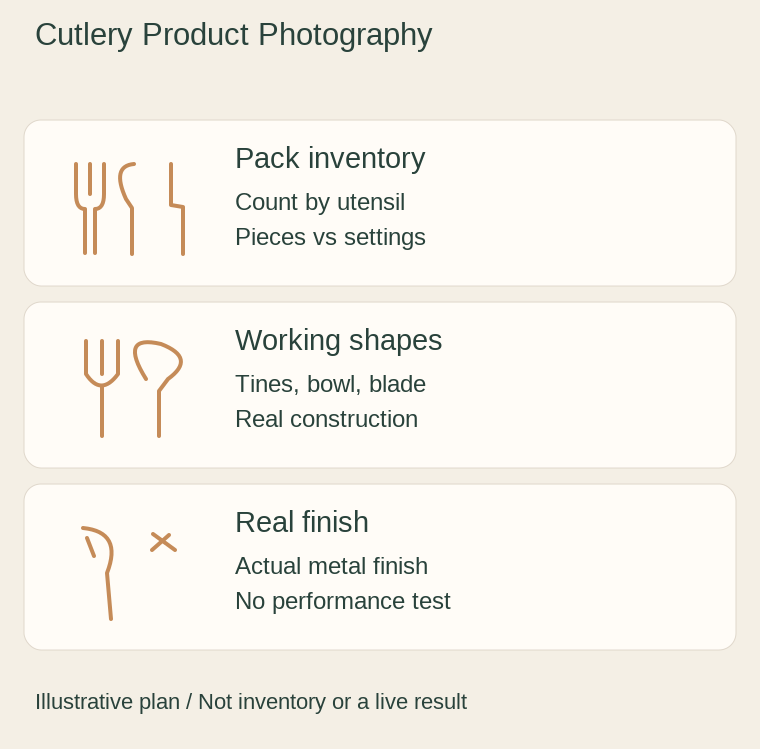
Original illustrative plan: Pack inventory, Working shapes, Real finish.
EDITORIAL CONCEPT
01 / EXAMPLEILLUSTRATIVE CONCEPT
What this shows

Give each view a specific job.

Use this illustrative plan to organize real evidence and a separate optional scene. The drawn objects and quantities do not specify the item you sell.

Original illustrative plan: Pack inventory, Working shapes, Real finish.
Editorial conceptOriginal teaching diagram. It is not a photograph of inventory, measured specification, live Fayvoro result or customer case.

This image is an editorial concept made for the site. It is not a Fayvoro generation or customer result. AI can change product shape, color, packaging, labels, and text. Check every important detail against the real item.

YOUR STARTING IDEA

Take the direction. Make it your own.

Use my real cutlery photograph for one simple unoccupied table scene. Add no utensils, food, plates or glasses absent from the reference. I will compare the actual tines, bowl shape, blade, handle finish and piece count with the product.
Add your reference photo in the studio, then adjust the direction.
Before you publish

Compare the result with your real product and your destination’s requirements.

  • Total piece count and per-setting composition agree with the actual pack.
  • Fork, spoon and knife details remain tied to real complete pieces.
  • Finish and proportions are reviewed under legible reflections.
  • Decorative tableware and performance claims are kept separate from the offer.
02 / A PRACTICAL WORKFLOWSTART WITH YOUR PHOTO
01

Inventory the sold set by utensil type

Lay out the current pack and count forks, knives, spoons and any smaller utensils separately. Record the total pieces and the actual place-setting composition rather than treating those figures as interchangeable. A product with four settings does not necessarily have the same piece count as another four-setting set.

Make an organized real inventory view and a separate representative place setting. Retain any supplied box as a packaging view. Iittala’s cited set identifies its own piece count and mirror-polished edition; use your own product record for construction, finish and contents rather than copying that specification.

Reusable Straw Product Photography — Record real bore/end profile, length, detachable tips and counted cleaning parts; do not imply drink compatibility or cleanliness from a styled glass.

02

Capture the working shapes and reflections

Photograph one complete fork and a close-up in which the actual tines are distinguishable. For a spoon, show both the outline and a real oblique bowl view. For a knife, keep the actual blade and handle connection readable without using a staged cut to imply a performance test.

Use a restrained light and background arrangement that shows the edges rather than a blown-out metal silhouette. A mirrored surface reflects the setup as well as the utensil. Compare finish, engraving and handle proportions with the physical pieces, and use real documented length or weight when those affect the purchase.

Spoon Rest Product Photography — Show the empty well, handle channel and underside; place an actual utensil only in a clearly excluded fit demonstration, never as proof of heat resistance.

03

Approve an optional dining scene separately

Trial one Fayvoro dining-table direction from a clear real source. The generator can merge utensils, add fork tines, flatten a spoon bowl or turn a matte finish into polished metal. Inspect the actual candidate against the inventory and detail photographs, including the number of displayed pieces.

Keep real set contents and construction photos in the gallery. Plates, napkins, glasses and food are props unless the offer includes them. A styled or generated scene cannot establish steel grade, dishwasher compatibility, balance in hand or cutting performance; those facts belong in supported product information.

Lunch Box Product Photography — Lay out the actual lid, seal, divider and included utensils, show the empty assembled interior and distinguish vessel capacity from a styled meal.

Common questions

A few things to know.

Can one place setting represent the entire set?

It can explain styling, but it may omit extra utensil types. Include a real whole-pack inventory and explicit counts.

Can generated metal highlights show the actual finish?

Not reliably. Compare the candidate with real finish references and retain the factual photographs.

Does a dining scene prove material or dishwasher suitability?

No. Those claims require the actual maker’s verified product information.

Make your image with intention.