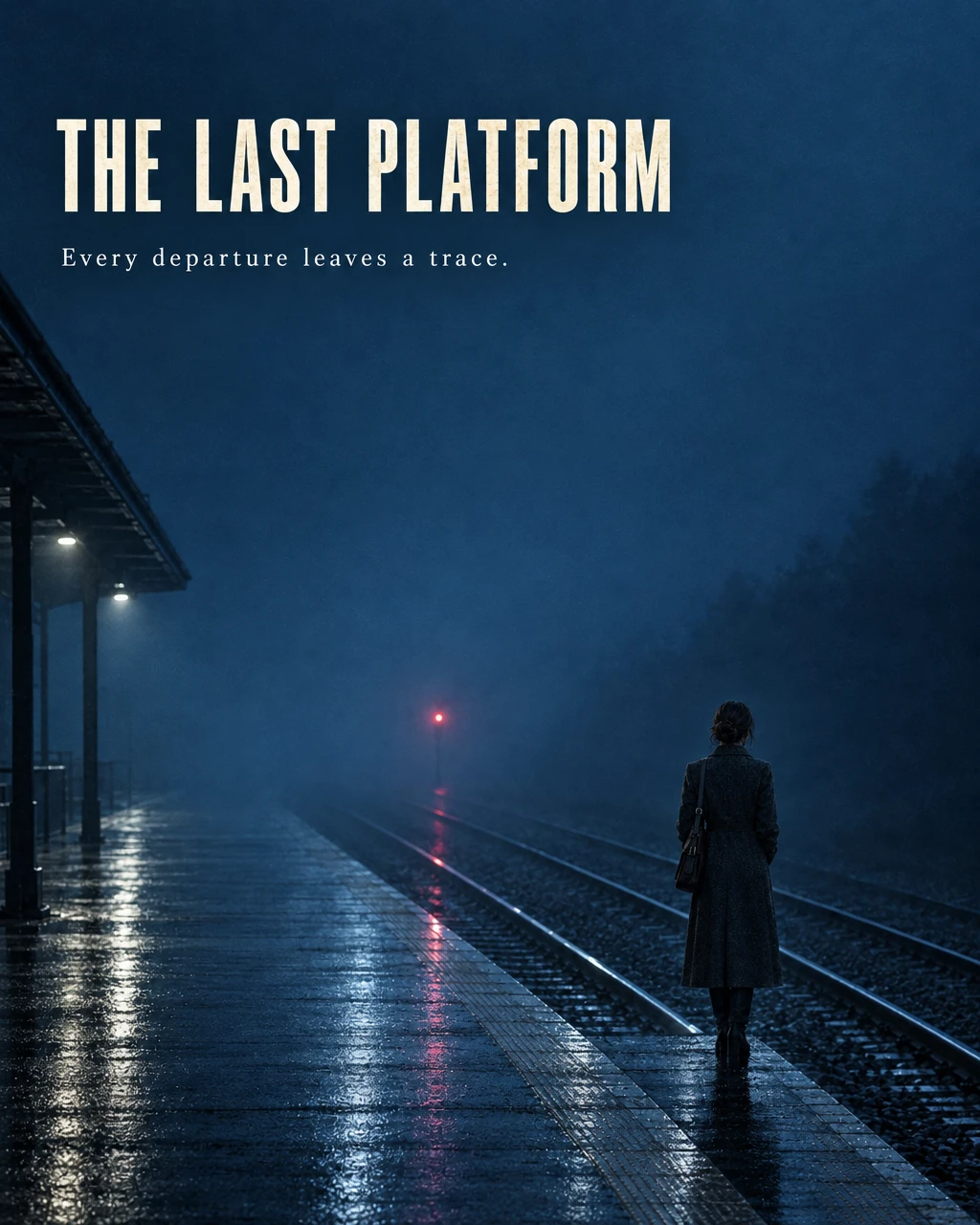
See the brief, the first poster, and one composition revision. Each pair was generated with Fayvoro.
THE LAST PLATFORM
An original mystery about an archivist who finds a vanished train platform. One adult woman, a deserted station and a red signal. Quiet tension, midnight blue and fog.
First draftSee the exact starting prompt
Original mystery film poster. An adult woman archivist in a long charcoal coat stands centered on a deserted railway platform at night. Converging wet rails vanish into dense blue fog; one distant red signal glows. Photographic cinema, restrained midnight blue, silver reflections, subtle grain. Large ivory condensed title at bottom: "THE LAST PLATFORM". Small tagline at top: "Every departure leaves a trace." Clear hierarchy, generous margins. No other words, logos or credits.
After one revisionSee the exact revision prompt
Edit this poster. Keep the same woman, charcoal coat, empty station, midnight-blue fog, red signal and exact wording. Move the woman into the lower-right third and make her half as tall; leave a vast empty foggy platform above and left. Put "THE LAST PLATFORM" in the upper-left, large ivory condensed type; place "Every departure leaves a trace." beneath it. Rails lead diagonally toward the signal. More negative space, quiet tension. No added objects, logos or credits.
AFTER THE SIGNAL
An original science-fiction drama: an astronaut follows an unexplained signal to a salt desert beneath a broken orbital ring. Copper and deep blue, human scale against a vast sky.
First draftSee the exact starting prompt
Original science-fiction film poster. A lone adult astronaut in a weathered ivory suit stands centered on a vast copper salt desert. An immense broken orbital ring arches through a deep midnight-blue sky, a tiny cyan signal at its fractured tip. Cinematic photorealism, dust haze, monumental scale. Large ivory geometric title across the lower third: "AFTER THE SIGNAL". Small top tagline: "Some answers arrive too late." Refined spacing, clean margins. No other text, logos or credits.
After one revisionSee the exact revision prompt
Edit this poster. Preserve the astronaut, ivory suit, copper salt desert, broken orbital ring, cyan signal and exact wording. Reframe as an extreme wide view: astronaut tiny in the lower-left, horizon at the bottom quarter; the ring enters from upper-right and dominates the sky. Place "AFTER THE SIGNAL" large in the open upper-left, with "Some answers arrive too late." below. Keep copper and midnight blue, cinematic realism, clear negative space. No added text, logos or credits.
SUNDAY, AGAIN
An original warm romance about two adults who meet every Sunday at a neighborhood bookshop. Soft watercolor, apricot light, teal shutters, modest everyday affection.
First draftSee the exact starting prompt
Original warm romantic film poster, hand-painted watercolor and colored pencil. Two adults in their thirties, one in a rust cardigan and one in a cream shirt, smile across a tiny outdoor bookshop table. Apricot afternoon light, teal shutters, cream paper texture, one small vase of daisies. Medium-wide centered composition, tender everyday mood. Elegant dark-teal serif title at top: "SUNDAY, AGAIN". Small bottom tagline: "The little days become a life." No other text, logos or credits.
After one revisionSee the exact revision prompt
Edit this poster. Preserve both adults, their rust cardigan and cream shirt, bookshop table, daisies, teal shutters, watercolor and warm apricot palette. Pull back: place the couple and table small in the lower-left, add airy cream wall across the upper half, and let a soft tree shadow cross the right edge. Set "SUNDAY, AGAIN" in large dark-teal serif type in the upper-right, with "The little days become a life." directly below. Keep all wording exact. No other text, logos or credits.
4:5 portrait · Flare · 1K. The revision uses the first poster as its reference. Exact English prompts are shown; new results will vary.
Make the next draft more yours.
In Create, review the brief and generate when you are ready. Then use the result as a reference and ask for one focused change: a smaller character, a different camera angle, or more space around the title.
Generated posters are flat images. Check title spelling, faces and details before sharing. For exact typography or print production, finish the text and layout in a design editor.
Yes. Enter a short title and review its spelling and placement in the generated image. Lettering can need revision; use a layout editor when typography must be exact.
Do I need to upload a photo?
No. Start with a title, story and genre, or add a reference image to guide a character or scene. The reference does not guarantee exact likeness.
Can I reproduce the examples?
Each example includes its original prompt and a revision prompt. Start from the draft prompt, or use the shown first draft as the reference for its revision. The same inputs can produce a different result.
Can I edit the title as a separate layer?
The generated poster is a flattened image, not an editable design template. Describe a change in the studio, or use a layout editor for separate text layers and print preparation.