PRODUCT STORIES / A CREATIVE GUIDE

Polarizing Filters for Product Photography

Reduce a reflection without inventing the finish.

A lens polarizer can affect some reflected light from glass or other non-metallic surfaces. It is an optical capture tool, not a universal way to delete every highlight.

Sign up for 3 free credits · Your starting direction is included.See the example
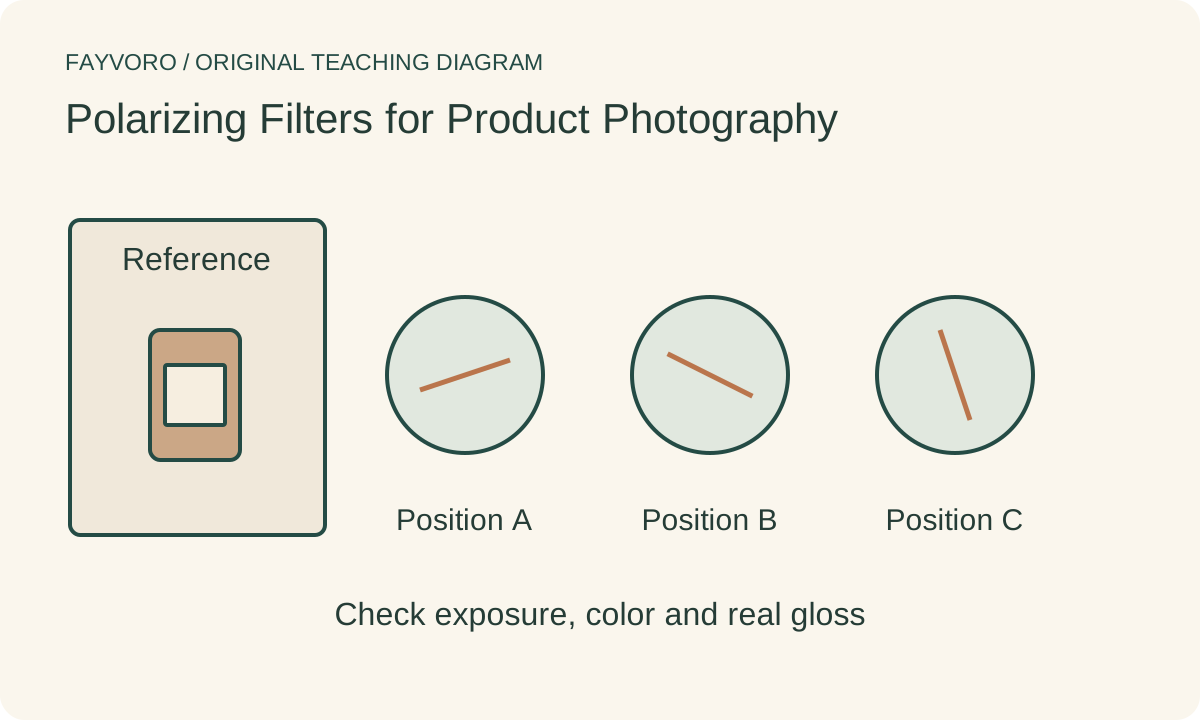
No-filter reference beside three illustrative lens-filter rotation positions, followed by exposure and surface-finish checks.
EDITORIAL CONCEPT
01 / EXAMPLEILLUSTRATIVE CONCEPT
What this shows

Retain the unfiltered reference.

Rotation positions illustrate a comparison record. They are not predicted reflection strengths.

No-filter reference beside three illustrative lens-filter rotation positions, followed by exposure and surface-finish checks.
Editorial conceptOriginal teaching diagram. It is not a measured lighting test, product photograph, Fayvoro result or customer case.

This image is an editorial concept made for the site. It is not a Fayvoro generation or customer result. AI can change product shape, color, packaging, labels, and text. Check every important detail against the real item.

YOUR STARTING IDEA

Take the direction. Make it your own.

Use my reviewed actual product photograph as the reference for one secondary scene. Keep the item visible and do not invent label text. I will compare gloss, color and surface detail with my real filtered and unfiltered captures.
Add your reference photo in the studio, then adjust the direction.
Before you publish

Compare the result with your real product and your destination’s requirements.

  • Surface type and no-filter reference are recorded.
  • Filter rotation is compared with camera and item fixed.
  • Exposure and focus are inspected after fitting the filter.
  • The accepted photo still fairly represents gloss and color.
02 / A PRACTICAL WORKFLOWSTART WITH YOUR PHOTO
01

Start with the surface and a no-filter frame

Photograph the real item without the filter and identify the detail hidden by glare. Note whether the surface is glass, plastic, coated material or bare metal. Tiffen describes reduced reflections from non-metallic surfaces; that does not establish reliable removal of metallic reflections.

Keep the camera and product fixed and select a filter compatible with the lens and camera. Consult the manufacturer about autofocus, exposure behavior and mounting rather than assuming any polarizing sheet can be fitted to a lens.

02

Rotate the filter and compare the actual result

Take a small set of frames at different rotation positions under the same illumination. Look at the label and at the rest of the surface, because the effect can vary across the item. Record the accepted position and retain a frame with ordinary reflections as a material reference.

The filter reduces transmitted light, so inspect exposure and focus after fitting it. Keep camera position consistent while compensating exposure. Do not treat a darker image as proof that the unwanted reflection has been solved.

03

Avoid changing the apparent product coating

Some reflections tell a shopper that a surface is glossy. Removing too much can make the same item appear matte or differently colored. Review the filtered capture beside the physical item and a normal reference, with the product owner choosing which view describes the finish fairly.

Cross-polarized lighting adds compatible polarization at the source as well as the lens and needs its own equipment-specific procedure. This guide does not provide that rig, guarantee a result or recommend placing improvised material on a hot light.

04

Keep optical evidence separate from generated glare

Fayvoro does not apply a physical polarizer or verify an optical capture. It creates a new scene candidate from a photo. A cleaner-looking generated highlight cannot establish the unseen label or real coating; retain accurate filtered and unfiltered photos for those facts.

Common questions

A few things to know.

Will a polarizer remove reflections from bare metal?

Do not assume that. The cited filter guidance concerns non-metallic surface reflections. Test the actual finish and use lighting control when needed.

Is cross-polarization just a rotating lens filter?

No. It also involves polarization at the light source. Follow compatible equipment instructions or work with a specialist.

Can Fayvoro provide the same optical proof?

No. It is not a polarization or measurement tool. Inspect a generated scene against real surface photographs.

Make your image with intention.