PRODUCT STORIES / A CREATIVE GUIDE

Knitting Needle Product Photography

Show the tips, the joint and the length of the usable assembly.

A circular needle’s cable and tips form one working assembly, while an interchangeable set has separate parts. Let buyers identify the actual connection and size combinations before a knitting-table image suggests a project.

Sign up for 3 free credits · Your starting direction is included.See the example
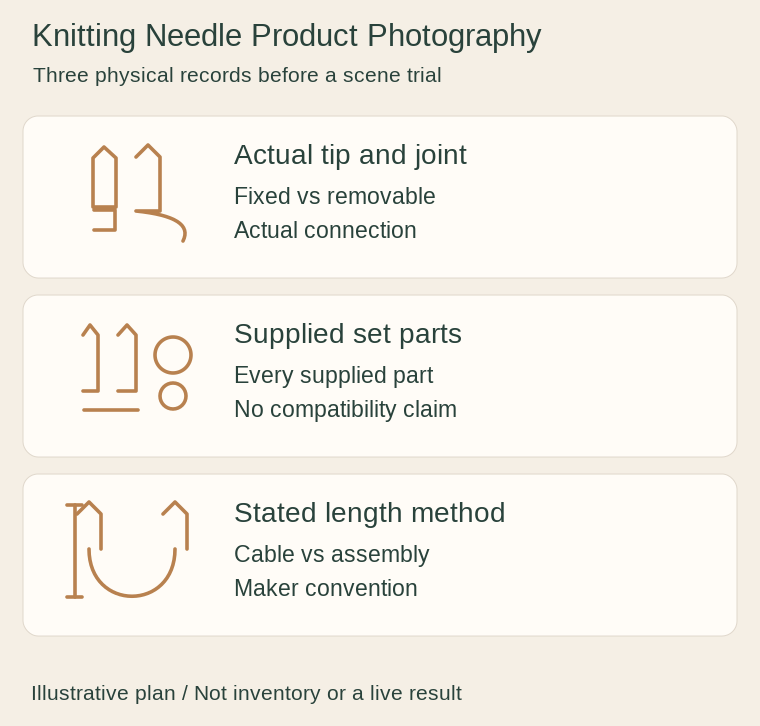
Original teaching plan: Actual tip and joint, Supplied set parts, Stated length method
EDITORIAL CONCEPT
01 / EXAMPLEILLUSTRATIVE CONCEPT
What this shows

Give each factual view a specific job.

The plan below separates actual product records from a possible secondary scene. Its drawings help organize the gallery; use your own physical item and verified records for every sale fact.

Original teaching plan: Actual tip and joint, Supplied set parts, Stated length method
Editorial conceptOriginal illustrative teaching plan. Fictional shapes, not a photograph of inventory, a Fayvoro output or a customer case. No dimensions, composition or performance facts are asserted.

This image is an editorial concept made for the site. It is not a Fayvoro generation or customer result. AI can change product shape, color, packaging, labels, and text. Check every important detail against the real item.

YOUR STARTING IDEA

Take the direction. Make it your own.

Explore one quiet knitting-table scene from my real needle photo. Add no yarn, knitted work, tips, connectors or markings. I will check the cable, joint, needle count and supplied parts against the actual assembly.
Add your reference photo in the studio, then adjust the direction.
Before you publish

Compare the result with your real product and your destination’s requirements.

  • Fixed or interchangeable joint is identified physically.
  • Every actual supplied part has a contents record.
  • Cable length and assembled length are distinguished.
  • Compatibility and gauge are not inferred from a scene.
02 / A PRACTICAL WORKFLOWSTART WITH YOUR PHOTO
01

Separate fixed and interchangeable construction

Photograph the actual needle tips and cable connection close enough to distinguish a permanent joint from a removable one. Keep the whole assembly visible in another view so a detail is tied to the specific range and size. Do not unscrew or force a connection that is not designed to separate.

KnitPro’s comparison explains fixed versus interchangeable circular construction. Use it as a task reference, not proof that tips and cables from different brands or ranges fit one another. Compatibility should follow the actual maker’s product records and physical configuration.

Crochet Hook Product Photography — Record hook head and throat profile, shaft size mark and grip separately; never substitute knitting needle geometry.

02

Record supplied parts and the measurement convention

Lay out the real sold set, separating tips, cables, caps, keys, connectors and case where supplied. Map each diameter or size marking to checked product text. A yarn ball in a project display is a prop unless included, and a partial opened set should not be used as a complete contents record.

Identify whether a length refers to the cable alone or a usable assembly including tips. Record the manufacturer’s convention and relevant real measurements instead of copying a general label. A curved tabletop arrangement cannot establish total length, tip diameter, joint smoothness or suitability for a project.

Stitch Marker Product Photography — Identify closed rings, split rings and locking markers, show the actual opening and count the supplied size assortment without claiming universal yarn fit.

03

Review a scene without changing the tool assembly

Use an approved whole-set or assembled-needle photo for one uncluttered knitting-table scene in Fayvoro. It may change tip count, turn a fixed joint into a connector, shorten the cable or add knitted fabric. The service does not guarantee interchangeable hardware or an exact technical layout.

Compare every visible tip, connection and supplied accessory with the source. Reject invented knots, broken cables or changed size markings. Retain the real joint and length records as buying evidence. A generated project scene does not demonstrate gauge, tool compatibility or an actual finished knitting result.

Common questions

A few things to know.

Is cable length always the full circular length?

No. Check and state the actual maker’s convention, including whether tips are part of the measurement.

Can I mix tips shown together in a generated scene?

A scene cannot establish compatibility. Use the relevant maker’s verified range information.

Does knitted fabric in an image prove gauge?

No. Gauge and project results require real work and measurements, not generated styling.

Make your image with intention.