PRODUCT STORIES / A CREATIVE GUIDE

Eyeglass Case Product Photography

Connect the closed shell to usable space inside.

A case exterior does not reveal whether a pair of folded glasses will enter or close comfortably. Show the same case open and closed, with an empty real lining and its actual fastening. A demonstrated frame fit is useful, but it is not a universal protection or compatibility claim.

Sign up for 3 free credits · Your starting direction is included.See the example
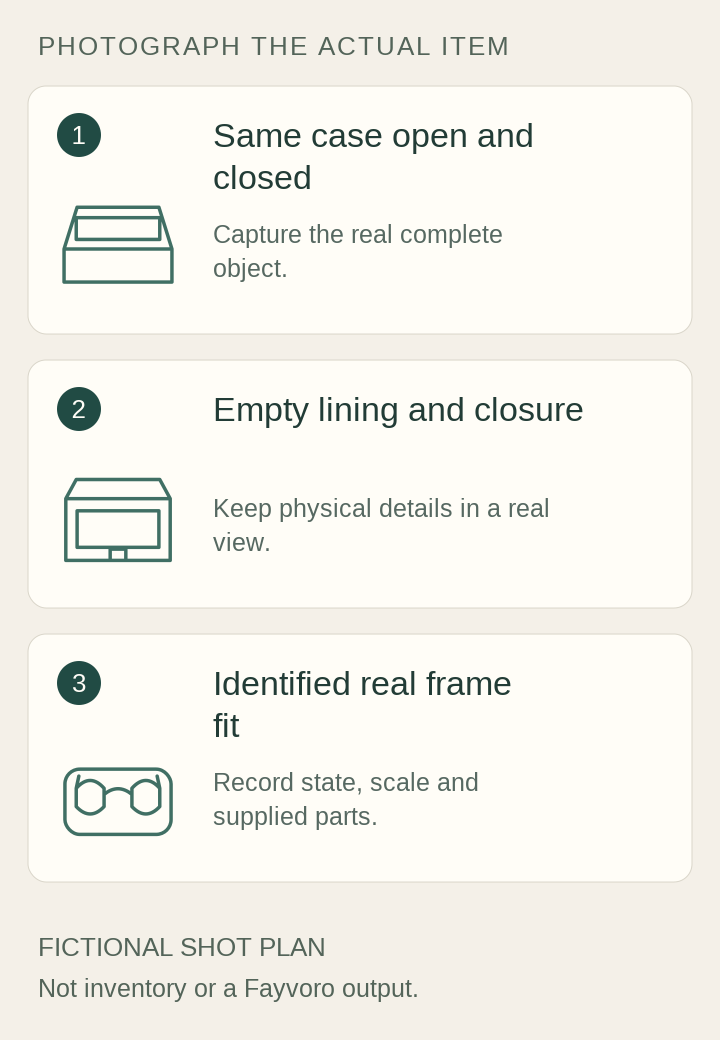
Original fictional shot plan: Same case open and closed, Empty lining and closure, Identified real frame fit
EDITORIAL CONCEPT
01 / EXAMPLEILLUSTRATIVE CONCEPT
What this shows

Give each real photograph a distinct job.

These original schematic views organize a physical shoot. Their geometry and labels are illustrative, not specifications for a manufactured item.

Original fictional shot plan: Same case open and closed, Empty lining and closure, Identified real frame fit
Editorial conceptOriginal fictional teaching diagram, not an inventory photograph, a Fayvoro output or a customer result. Use real photos for dimensions, construction, condition and included parts.

This image is an editorial concept made for the site. It is not a Fayvoro generation or customer result. AI can change product shape, color, packaging, labels, and text. Check every important detail against the real item.

YOUR STARTING IDEA

Take the direction. Make it your own.

Place my actual empty eyeglass case on a plain tabletop. Retain its visible opening, lining and closure. Add no glasses, cloth, mirror, magnet, extra compartment or text. I will inspect the cavity and hinge against the original.
Add your reference photo in the studio, then adjust the direction.
Before you publish

Compare the result with your real product and your destination’s requirements.

  • Open and closed photographs use the same case variant.
  • Empty lining, hinge and closure remain visible.
  • Usable interior is measured separately from outside size.
  • Real fit glasses and optional cloths are clearly excluded.
02 / A PRACTICAL WORKFLOWSTART WITH YOUR PHOTO
01

Photograph the open lining and real closure

Begin with the actual case closed, then open it within its normal hinge or folding range. Keep the lining, hinge edge, closure and interior base visible. Photograph a soft pouch as a pouch, a folding case unfolded if designed for that, and a rigid shell without altering its construction to suit a styled scene.

MOSCOT’s Originals Case separately describes its lining and snap-button closure. These are construction facts to check rather than a universal eyewear-fit guarantee. Keep the same boundary in your offer: a case photograph must not imply that glasses are included. Match the actual variant, lining and supplied cloth instead of combining an exterior with another case’s interior.

02

Check a real frame against the usable interior

Record outside packing dimensions separately from internal length, widest useful area and clearance through the opening. Padding and hinge geometry can reduce the usable space. A case that is longer than a folded frame may still be too shallow for the lenses or temple curve.

For a fit demonstration, identify the actual frame and show normal placement followed by an unforced closed view. Exclude the glasses from the sale unless supplied. Keep scratches, compressed lining and closure wear visible for used stock. A sleek shell cannot establish crush resistance, scratch prevention or compatibility with every frame shape.

03

Inspect the hinge and cavity after scene exploration

Use your own empty-case photograph in Fayvoro and request a quiet dressing-table setting. Compare shell outline, lining edges, hinge position and closure against the source. AI may enlarge the cavity, add a magnetic flap or invent a pair of glasses that appears to fit because its proportions changed.

Keep real empty and fit photographs in the final gallery. Reject added cloths, frames or accessories that change the offer, and do not treat an imagined fall or travel scene as a protection test. The editorial diagram is a fictional shot plan rather than a verified case model, inventory item or customer result.

Common questions

A few things to know.

Does a long case automatically fit a large frame?

No. Check interior width, depth, opening and the actual folded frame, then close the case without forcing it.

Can an attractive shell photo prove protection?

No. Protection claims need separate substantiated evidence for the exact product and test conditions.

Make your image with intention.