PRODUCT STORIES / A CREATIVE GUIDE

Bracelet Product Photography

Let the closure and the usable space explain the bracelet.

A closed bracelet can look like a neat circle while hiding the clasp, flexible links and space available for a wrist. Build the gallery around those three choices before trying a secondary jewellery scene.

Sign up for 3 free credits · Your starting direction is included.See the example
Original teaching plan: Open / closed, Clasp and links, Actual size method
EDITORIAL CONCEPT
01 / EXAMPLEILLUSTRATIVE CONCEPT
What this shows

Give each factual view a specific job.

The plan below separates actual product records from a possible secondary scene. Its drawings help organize the gallery; use your own physical item and verified records for every sale fact.

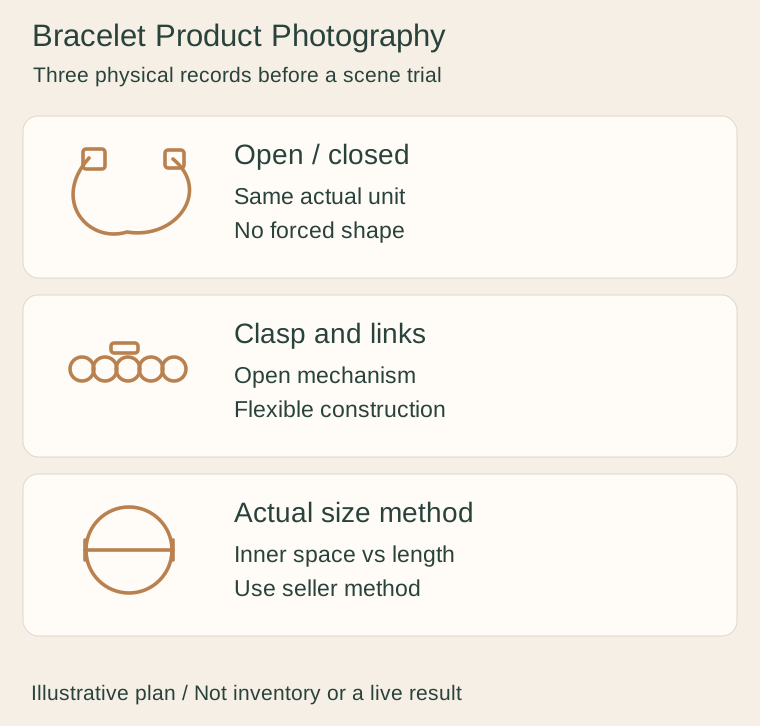
Original teaching plan: Open / closed, Clasp and links, Actual size method
Editorial conceptOriginal illustrative teaching plan. Fictional shapes, not a photograph of inventory, a Fayvoro output or a customer case. No dimensions, composition or performance facts are asserted.

This image is an editorial concept made for the site. It is not a Fayvoro generation or customer result. AI can change product shape, color, packaging, labels, and text. Check every important detail against the real item.

YOUR STARTING IDEA

Take the direction. Make it your own.

Use my real bracelet photograph as the reference for one quiet jewellery-tray scene. Add no wrist, extra bracelets, charms or markings. I will verify the closure, links and outline against my original images.
Add your reference photo in the studio, then adjust the direction.
Before you publish

Compare the result with your real product and your destination’s requirements.

  • Open and closed views belong to the same sold configuration.
  • Size names distinguish inner space from total length.
  • Optional charms and display stands are not implied contents.
  • Generated links and fastening are checked against the real unit.
02 / A PRACTICAL WORKFLOWSTART WITH YOUR PHOTO
01

Photograph the same bracelet open and closed

Begin with the actual sale unit on a surface that lets the full outline read clearly. Make a closed view for its normal shape and an open view for the fastening, where the design permits ordinary opening. Do not straighten a rigid bangle or force a hinge just to create a tidier composition.

Keep charm positions and adjustable ends recognizable between the views. For a flexible chain, add an oblique detail that shows how the links articulate. If detachable charms are optional, distinguish the base bracelet from the configured offer; an attractive stack should not imply that several bracelets or every displayed charm are included.

02

Record size using the bracelet’s own method

Interior circumference, end-to-end length and a bangle’s inside diameter are different measurements. Use the method documented for the specific construction, photograph the real endpoints and put checked values in the listing. Pandora’s guide illustrates why sizing advice depends on bracelet style; do not copy one brand’s allowance as a universal fit rule.

A permitted real wrist view can suggest placement, but it does not replace dimensions or establish comfortable fit for every buyer. Pair it with an uncluttered clasp detail and the relevant measured view. Keep any material, stone, weight or allergy-related statement tied to verified product information.

03

Review a single display-scene candidate

Choose a clear real reference in which the whole bracelet is visible, then explore a restrained tray or tabletop setting. Fayvoro creates a new image; it may change a clasp, link spacing, charm arrangement or circle shape. It does not provide a guaranteed wrist fitting or exact jewellery mask.

Compare the candidate with the open and closed originals at full size. Reject a joined clasp that was originally separate, duplicated charms, missing links or an implausible hinge. Keep the factual closure and size images in the gallery even if the scene is attractive. A display photograph cannot prove fastening strength or metal purity.

Common questions

A few things to know.

Should I straighten every bracelet?

No. Show the normal shape of the actual construction, with an open view only when it can be handled normally.

Can an AI wrist image establish fit?

No. Keep physical measurements and the seller’s sizing method. This page demonstrates no reliable virtual wrist fitting.

Is the bracelet diagram a stocked item?

No. It is a fictional shot plan, not inventory, a Fayvoro result or a merchant case.

Make your image with intention.