PRODUCT STORIES / A CREATIVE GUIDE

Playing Card Product Photography

Keep the printed deck faithful on both sides.

Playing-card buyers may care about exact indices, back artwork, cut edges and what is inside the box. A dramatic fan can hide those details. Build a gallery from real printed cards and the actual complete pack, separating artwork proofs from production stock and handling claims.

Sign up for 3 free credits · Your starting direction is included.See the example
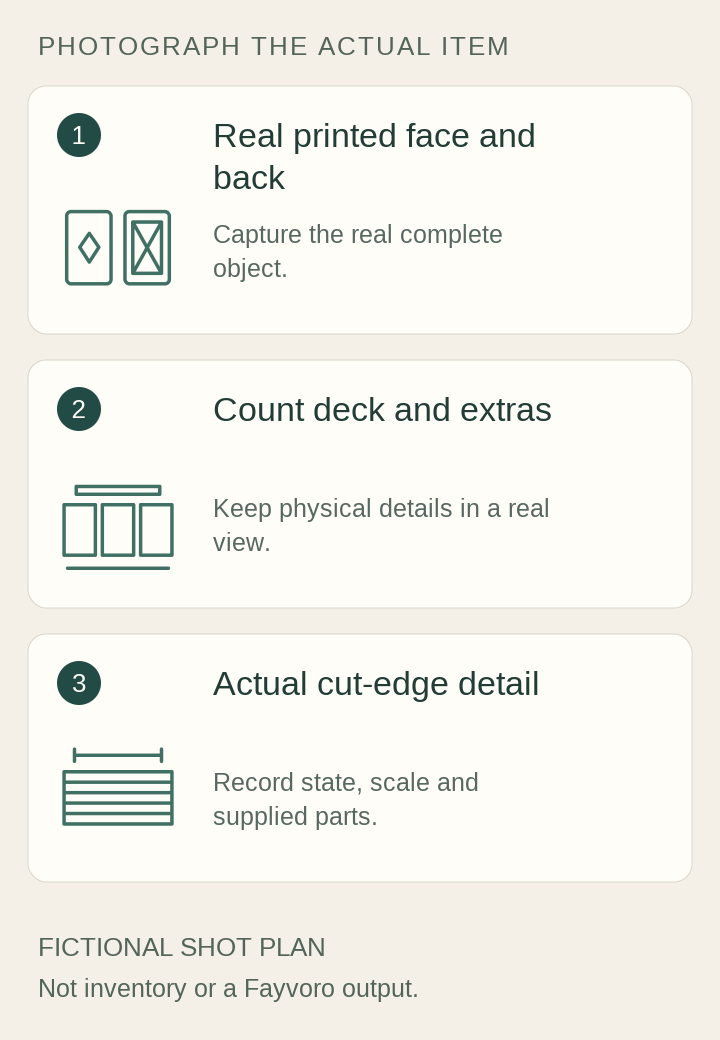
Original fictional shot plan: Real printed face and back, Count deck and extras, Actual cut-edge detail
EDITORIAL CONCEPT
01 / EXAMPLEILLUSTRATIVE CONCEPT
What this shows

Give each real photograph a distinct job.

These original schematic views organize a physical shoot. Their geometry and labels are illustrative, not specifications for a manufactured item.

Original fictional shot plan: Real printed face and back, Count deck and extras, Actual cut-edge detail
Editorial conceptOriginal fictional teaching diagram, not an inventory photograph, a Fayvoro output or a customer result. Use real photos for dimensions, construction, condition and included parts.

This image is an editorial concept made for the site. It is not a Fayvoro generation or customer result. AI can change product shape, color, packaging, labels, and text. Check every important detail against the real item.

YOUR STARTING IDEA

Take the direction. Make it your own.

Set my actual playing-card reference on one plain tabletop. Preserve the photographed arrangement and visible printed artwork. Add no card, new symbol, changed index, chips or text. I will compare every printed mark with the original.
Add your reference photo in the studio, then adjust the direction.
Before you publish

Compare the result with your real product and your destination’s requirements.

  • Real faces and common back are separately legible.
  • Jokers, extras and tuck box have a counted record.
  • Cut edges and registration come from physical cards.
  • Generated symbols never replace actual printed artwork.
02 / A PRACTICAL WORKFLOWSTART WITH YOUR PHOTO
01

Photograph real faces and the shared back

Choose representative actual faces that reveal index position, suit symbols, borders and illustration detail. Capture the common back square to the camera as a separate view. Use flat lighting for legibility before adding a raking-light detail of texture or foil; one lighting setup rarely explains both clearly.

Bicycle’s custom-printing page distinguishes stock, ink, finish and handling attributes. Those categories remind a seller to preserve physical print evidence rather than treating a design file as the finished deck. Do not describe your own cards as using another maker’s proprietary finish or paper simply because they look similar.

02

Reconcile the pack and inspect the edges

Count the actual playing cards, jokers and any instruction or advertising cards separately. Show the tuck box and seals as supplied, recording whether a photographed open sample differs from the sealed sale stock. A standard-deck assumption can hide missing cards or extras in an independently illustrated edition.

Capture a real stacked edge and a restrained fan to show alignment, cut and printed border consistency. Record physical dimensions from an actual card. A smooth fan photograph is not proof of shuffle quality, stiffness or long-term wear, and digital artwork cannot establish ink registration on the printed item.

03

Keep AI away from factual card artwork

For a Fayvoro scene trial, begin with an owned photograph of the actual closed tuck box or a simple real card arrangement. Inspect every visible index, suit, border and back motif at full size. AI may duplicate symbols, change values or invent a different illustration while preserving the overall palette.

Use the real close-ups and counted deck record as the listing’s factual evidence. Reject a styled result with altered printed content instead of accepting almost-correct artwork. The fictional teaching diagram does not depict a real edition, complete inventory or handling test, and no illustrated card design here is offered for sale.

Common questions

A few things to know.

Can a digital proof replace photographs of printed stock?

Label it as a proof if used. Keep real production photographs for print colour, edge and finish evidence.

Should every deck be assumed to contain the same extras?

No. Count that edition’s playing cards, jokers and additional cards, and state what is supplied.

Make your image with intention.